
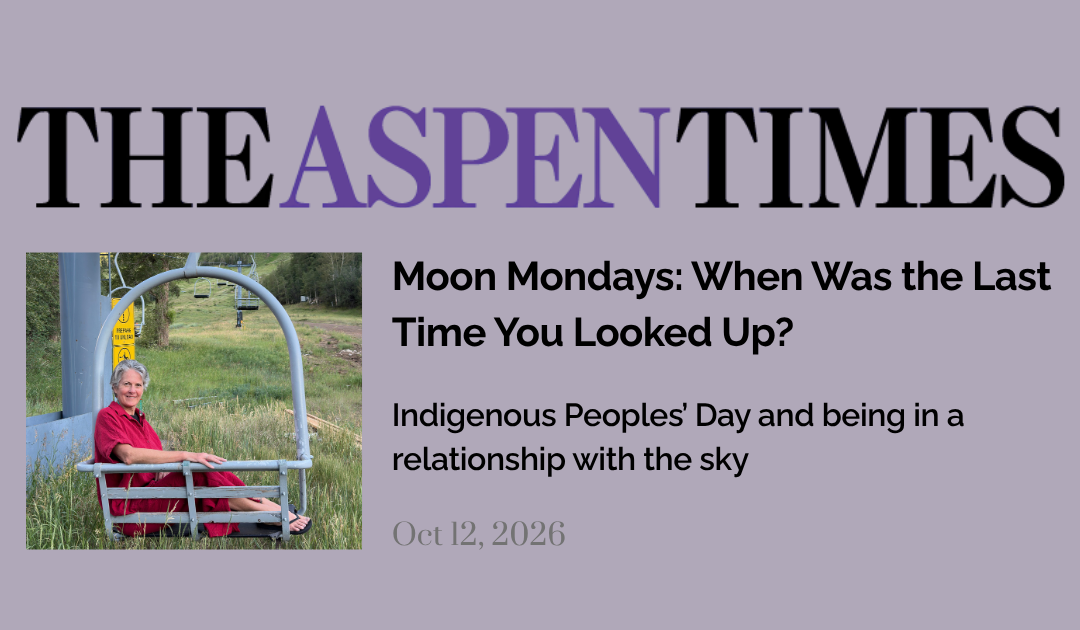
Moon Mondays: When Was the Last Time You Looked Up?
Indigenous Peoples’ Day and being in a relationship with the sky
I’m as guilty as the next gal. Despite my best intentions, I pop outside and connect with the sky in fits and starts. Sometimes I’m all over it, watching the sunset every night and honoring the solstices, the moon, and Venus cycles with ceremony. Other times I’m just phoning it in, with a quick peek out my bedroom window. And more often than I care to admit, I’m sadly oblivious until I look up and the moon’s phase or the sun’s angle catches my attention.
How often do we actually look up anymore? We check an app to see what phase the moon is in. We look at astrology software to see where Venus is. I’m calling myself out here, too. We know intellectually that the equinox came and went — but how often do we experience ourselves as living within the sky and its cycles?
As we acknowledge Indigenous Peoples’ Day today, I can’t think of a more reverent time to honor the true locals and their deeply rooted relationships with the earth and sky — connections they maintained despite the horrific efforts to sever them from their traditions.
We aren’t separate from the sky either. We belong to the terrestrial and celestial cycles, just like our ancestors from other lands.
Astrology can easily become another way of collecting information — data. I know where the planets are. I know what they mean. I know what my birth chart says. But knowing isn’t the same as being in a relationship.
When I’m on it and in my groove, being in connection with the sky feels like reverence, gratitude, and awe. I can sit still for long stretches (sans my phone) and simply be. I feel a communion with the sky, like we’re in an exchange — breathing in and out together. I also experience this sense of unity when I walk in the mountains, sit with a tree or lie by the river.
When I’m not on it and light-years out of my groove, I’ll suddenly come to at the end of a hike with no idea what just happened or how I got there. It’s like I’ve left my body, so absorbed in my head that I’ve lost all sense of where I am. I feel so creepily disconnected in those moments.
What connections am I missing because I’ve stopped paying attention?
The Ute people were looking at this sky long before the rest of us got here — like many millennia long — not the oft-admired ’60s or ’70s. As we judge and shame one another’s “localness,” we have mountains to learn from the Utes, who migrated through, lived with, and embodied what we now call “our” valley, “our” town, “our” land. Let’s remember that the next time we’re whining about how much things have changed since we first arrived here (waaayafter the Utes).
That distinction between knowing about something and being in a relationship with it applies to astrology, too. We’re often looking to the planets for answers. How about this week, instead of asking the sky to tell us something about ourselves, we go outside and simply be with what’s above and around us? Look up, chill out, and notice what comes alive inside of us.
What happens when the question shifts from what can the planets tell me? to what does it mean for me to be in a relationship with the sky? And then take it one step further: Whose land am I standing on when I look up? Who was watching these mountains, seasons, moon, sun, and stars before me?
On Indigenous Peoples’ Day, I’m reconsidering what — and whom — I value enough to be in a relationship with rather than merely consume. Reverence asks me to stop looking at everything around me for what it can do for me and instead consider what I can offer in return — to the sky, the earth, and each other.
Sheridan🌙
Moon Sisters Circle, Astrologer, and Astrology for Real Life Coaching